







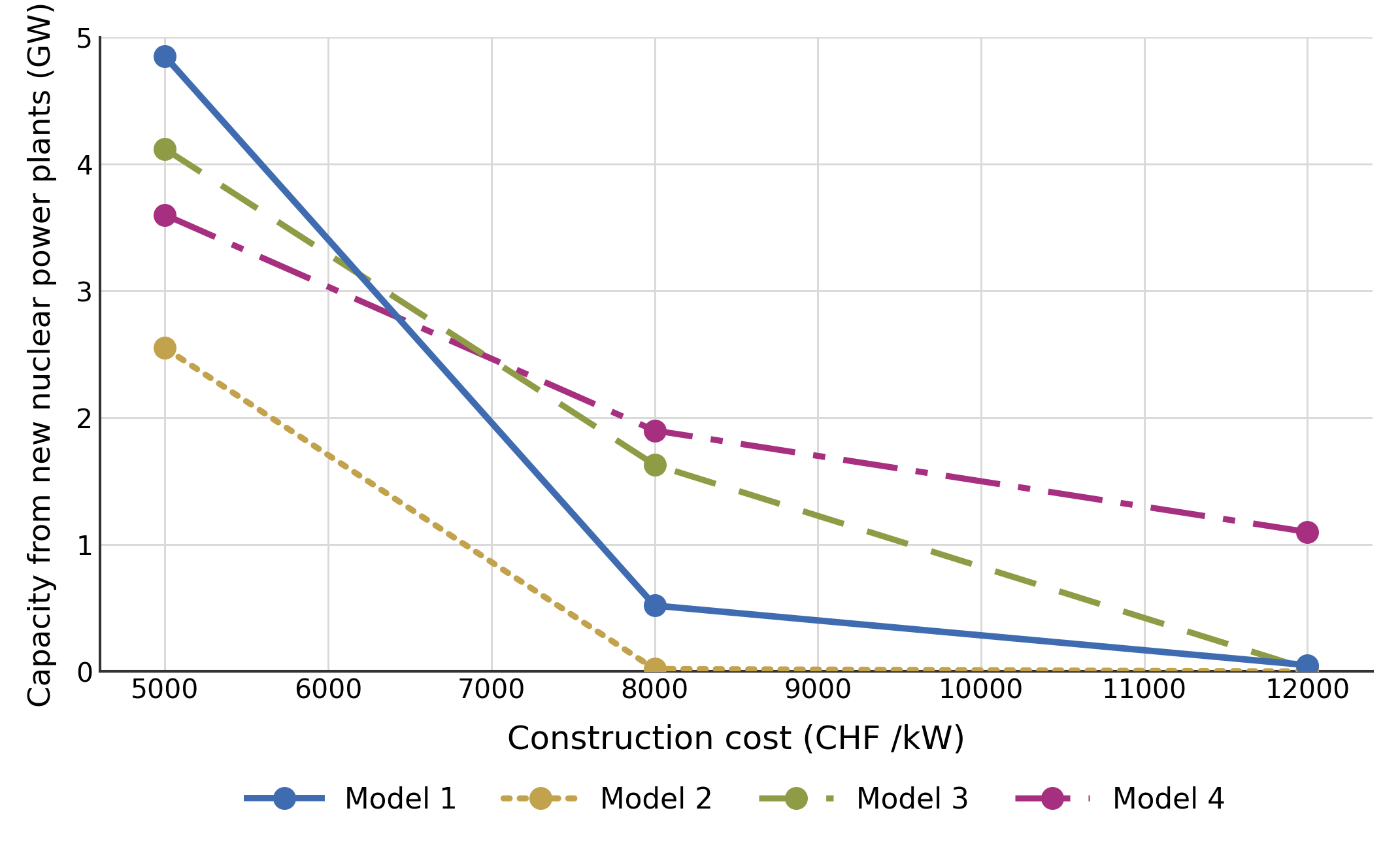
On 29 June 2026, ETH Zurich and the Paul Scherrer Institute published a joint white paper by nineteen researchers across four independent energy-system models. Its message is clear: new nuclear becomes competitive in Switzerland once three conditions line up, the state backs nuclear alongside renewables, financing costs fall from roughly 8% to 5% through guarantees or contracts for difference, and construction costs move toward CHF 8,000 per kilowatt or below. The lower the build cost, the stronger the case: new nuclear pencils out in one of the four models even at CHF 12,000 per kilowatt, and in more of them as costs fall toward CHF 5,000.
That is the tension: Parliament made new plants possible while withholding the very support the study calls their precondition. Lifting the ban is right, but only half a decision. The five questions below set out what was decided, what was left out, and what still has to be settled before the vote.
A permit is not a power plant. Parliament legalized the building and, in the same breath, outlawed the one thing that would make it bankable.
1. What did Parliament actually decide, and what did it leave out?
On 18 June 2026 the National Council, following the Council of States, adopted the Federal Council's indirect counter-proposal to the “Blackout stoppen” initiative by 108 votes to 87, making new nuclear plants legally buildable for the first time in fifteen years. Concretely, the counter-proposal deletes Article 12a and Article 106 para. 1 bis of the Nuclear Energy Act (KEG), the provisions that since 2018 barred any general license for a new plant, and inserts a requirement that financing be secured in advance. On its face, this restores technology neutrality. But the parliamentary majority went further than mere permission: the National Council line rejects state support for new reactors and would grant a framework license only where the construction and operation of a plant are financially assured on private terms. In other words, the legislator has re-opened the door and, at the same time, removed the ramp that leads to it. The decision answers the question of legality. It leaves entirely open the question that actually governs whether a plant ever gets built: who carries the multi-decade financial risk, the very point the ETH study puts front and center.
2. What does the ETH study show, and where do we part ways?
The arithmetic is careful, and on its own terms it holds: new plants become competitive once the state supports them, financing costs fall from around 8% to 5%, and construction costs move toward CHF 8,000 per kilowatt. We accept that. But two features deserve emphasis. The analysis does not model small modular reactors as a technology in their own right. It represents nuclear through a single capital cost per kilowatt of installed capacity, and its most expensive case, CHF 12,000 per kilowatt, is taken from recent first-of-a-kind gigawatt projects in Europe and the United States. The authors themselves attribute those prices to being the first of their kind, and expect learning to bring costs toward CHF 8,000. The serial, factory-built logic of modular reactors is exactly the route to the lower costs at which the models turn positive, yet it lies outside them. And while it is right that Switzerland could reach net zero without new nuclear, leaning on hydropower and photovoltaics for roughly three quarters of supply, that path quietly accepts structural winter import dependence as its price. That is what we are not willing to accept. A high first-of-a-kind cost is an argument for a serious build program and a sound financing framework, not for treating nuclear as optional.
3. How much nuclear does Switzerland need to stay sovereign?
Enough to stay in control of its own winter supply. Demand is set to climb from about 57 terawatt-hours today to between 75 and 90 by 2050 as transport, heating and industry electrify, just as the existing reactors, some 23 terawatt-hours, reach the end of their lives. On a cold, windless winter night, solar and run-of-river hydro cannot cover that load, and the gap is filled by imports from neighbors whose own margins are shrinking. A firm domestic baseload of 25 to 30 terawatt-hours, roughly nuclear's share today carried into a larger system, would keep that capacity in Swiss hands instead of surrendering it to a market the country does not steer. Letting the fleet retire unreplaced does the opposite. That reactors are slow or costly to build is an argument about execution, not direction, and the technology answers part of it: the latest designs, including the small modular units now nearing deployment, are markedly safer than the plants they would replace, built around passive safety and a far smaller footprint. The wiser course is to treat that firm capacity as the strategic asset it is, a dependable foundation for the country's future supply.
4. Is there a lawful financing path, and should the state take it?
There is, and Switzerland has the legal tools to build it. A contract for difference, under which the state guarantees a fixed strike price and settles the gap either way, is the instrument the ETH authors point to, and it is precisely what the National Council line refuses. Introducing it would mean squaring it with the Electricity Supply Act (StromVG), the Energy Act (EnG) and the 2024 “Mantelerlass” on secure electricity supply from renewables, and treating it honestly as state aid. None of that is a barrier so much as a design task: the European Union already uses a contract for difference for new nuclear, at Hinkley Point C, which shows the instrument is workable rather than forbidden and gives Switzerland a template to negotiate around in its own electricity talks with Brussels. Behind the build cost sits the long tail, liability under the Nuclear Energy Liability Act and the decommissioning and waste-disposal fund, and a serious framework prices that in from the start. These are reasons to design the financing carefully. They are not reasons to leave the permission empty.
5. What should be decided now, in the window before February 2027?
The supply gap is real, and it widens as the economy electrifies: petrol cars give way to electric ones, oil and gas boilers to heat pumps, fossil-fueled industrial processes to electric ones, and digital infrastructure and data centers add load of their own. Without firm domestic baseload, Switzerland will meet that rising winter demand with imports, year after year. That is an argument for deciding seriously, not for deciding halfway. If the country wants the nuclear option to be genuine, it must legislate the financing architecture the ETH study itself identifies as the precondition: a defined risk-transfer mechanism, a bankable license framework, and a clear-eyed answer on state aid and the EU electricity file. What it should not do is what it has done so far: permit the plant, forbid the financing, and leave investors to reconcile the contradiction. Switzerland has made the easy half of the decision. The hard half is still on the table, and the months before the vote are the time to put it there.
Opponents, among them the Schweizerische Energiestiftung, the Social Democrats and the Greens, read the same study as proof that new nuclear is neither economic nor necessary, and want the repeal rejected at the ballot. We read it differently. A system in which net zero is technically reachable without nuclear is not the same as a supply that stays secure, sovereign and affordable in the depths of winter. Cost is a reason to structure the financing intelligently, not a reason to rule out a technology the country will need.
Our view
From a legal and economic perspective, repealing the new-build ban is only a first step, not yet a bankable investment framework. As long as the legislature does not create a financing architecture that investors can rely on, the planning certainty infrastructure investment requires is missing. Our position is clear, and it is not the study's: Switzerland needs new nuclear. Holding a firm domestic baseload on the order of 25 to 30 terawatt-hours, enough to keep roughly today's nuclear share as demand climbs toward 75 to 90 terawatt-hours by 2050, is what genuine energy sovereignty looks like, the difference between generating our own power and depending on imports we do not control. The latest reactor technology is markedly safer than the plants it would replace, and it belongs at the center of the country's energy infrastructure, not at its margin. Permission without financing is symbolism, not location policy. Switzerland should finish the decision it has started: commit the financing, build the capacity, and secure its own supply.
Dr. iur. Alexander Schiemenz is a co-founder of TND Universe, which creates, invests in and delivers exceptional real estate, mobility and energy solutions that shape better communities and brighter futures. If you are planning to invest in energy infrastructure, get in touch for legal insights and energy concepts that turn a permitted project into a bankable one.