On 1 April 2026, Switzerland's Acceleration Decree came largely into force, shortening permitting and appeal procedures for large solar, wind and hydropower installations of national interest. Eleven weeks later, on 19 June, Parliament lifted the fifteen-year ban on new nuclear plants, and left the licensing architecture for those plants exactly where it was, adding one new condition at the entrance. Demand is heading from roughly 60 terawatt-hours today toward 68 to 81 by 2050. The country now runs two permitting regimes for the same grid: a fast lane for renewables, and for nuclear the old road, with a new toll booth at the start of it.
We have made this argument in two parts already: in June, that the winter supply gap makes this a sovereignty question rather than an energy-policy preference; in July, that Parliament legalised the plant while refusing the financing that would make it bankable. This is the third part, and the one nobody is debating: the procedure.
1. What does the nuclear licensing procedure actually require today?
Three stages, in a fixed order. The first is the framework licence, the Rahmenbewilligung, granted by the Federal Council under Art. 12 para. 1 of the Nuclear Energy Act (KEG), submitted to the Federal Assembly for approval, and subject to the optional referendum (Art. 48 paras. 1, 2 and 4 KEG). The Assembly is not a rubber stamp in one direction only: if the Council refuses and the Assembly declines to endorse that refusal, it instructs the Council to grant the licence (Art. 48 para. 3).
Only then come the construction and operating licences, both granted by the federal department (Art. 15 and 19 KEG). The construction licence presupposes a legally final framework licence and a project that complies with it (Art. 16 para. 2). These stages run under the Administrative Procedure Act; no cantonal permits are required, and the host canton is heard and may appeal if the department licenses over its objection (Art. 49 paras. 1, 3 and 4).
What Parliament changed in June was the prohibition, not the architecture. The two ban provisions were deleted, together with the cross-reference to them in Art. 12 para. 1, and a condition was added that a framework licence may be granted only where construction and operation are financially secured. The legislator declined to write a ban on federal participation into the law, and has not designed one either. The sequence a sponsor must fund is unchanged, and it now carries an additional hurdle placed before the first stage rather than after it.
2. Why is the first stage the most expensive risk?
Because duration and risk are not the same cost. Duration is a financing problem: more interest capitalised before the first franc of revenue. Painful, but calculable. Risk is an equity problem: the possibility that money already spent produces nothing at all, priced not in basis points but in the return an investor demands before committing anything.
Swiss nuclear licensing concentrates that second cost at precisely the wrong place, and it does so in the statute rather than in practice. Art. 12 para. 2 KEG provides that there is no legal entitlement to a framework licence. The Federal Office of Energy spells out the consequence in its own materials: a refusal must be accepted by the applicant without compensation. Set that beside the condition Parliament has now added, and the sequence reads as follows.
Secure the financing first, for a licence the law says you have no right to, and whose refusal costs the state nothing.
That is not a drafting oversight; it is a genuine circularity, and the most expensive single feature of the Swiss framework. A financing structure must be demonstrated in advance of a decision that is political in character, that no applicant can compel, and whose failure the applicant bears alone. Andreas Pautz, professor of nuclear engineering at EPFL and head of nuclear energy and safety research at the Paul Scherrer Institute, made the same point in the NZZ on 10 August: the dominant risks are planning risks, meaning objections and adverse popular votes, and investors will demand a premium for them.
The asymmetry runs through the timing too. The framework licence sets a deadline for filing the construction application and lapses if it is missed (Art. 14 para. 3 and Art. 68 para. 2 KEG). The clock runs against the sponsor; no comparable clock runs against the authorities.
3. What would dropping the framework licence cost in law?
Pautz proposes waiving it at the existing sites of Gösgen and Leibstadt: Western reactor designs are licensable in Switzerland in principle, those sites have demonstrated their suitability, and a two-stage procedure would, he argues, not offend Swiss democratic principles since the construction and operating licences remain. On the substance that is defensible; the technical assessment sits in those later stages.
But the stage is not only a technical filter. It is where the optional referendum sits (Art. 48 para. 4) and where participation is concentrated: application, expert opinions and cantonal positions lie open for three months, anyone may file objections, and parties may lodge formal opposition (Art. 45 and 46 KEG). Delete the stage and you delete a federal referendum right and the principal participation window with it. That engages the guarantee of access to a court under Art. 29a of the Federal Constitution and pushes objections downstream rather than removing them.
For capital, the consequence is counter-intuitive and decisive. Political risk does not disappear when the vote is removed; it relocates: to the construction licence, where the host canton keeps its own appeal right, and to a fresh popular initiative aimed at the outcome. A procedure that removes the ballot without putting finality in its place buys a few years and sells the certainty that made those years worth buying. That is our one departure from an otherwise sound analysis: keep the stage, and make the framework around it bankable.
4. What is actually missing, then?
Less than the acceleration rhetoric suggests, and something more specific. Two of the elements usually demanded already exist: preclusion, since whoever does not file opposition within the inspection period in the construction-licence procedure is excluded from the remainder of the proceedings (Art. 55 para. 1 KEG), and binding effect downward, since the construction licence requires a legally final framework licence and compliance with it (Art. 16 para. 2).
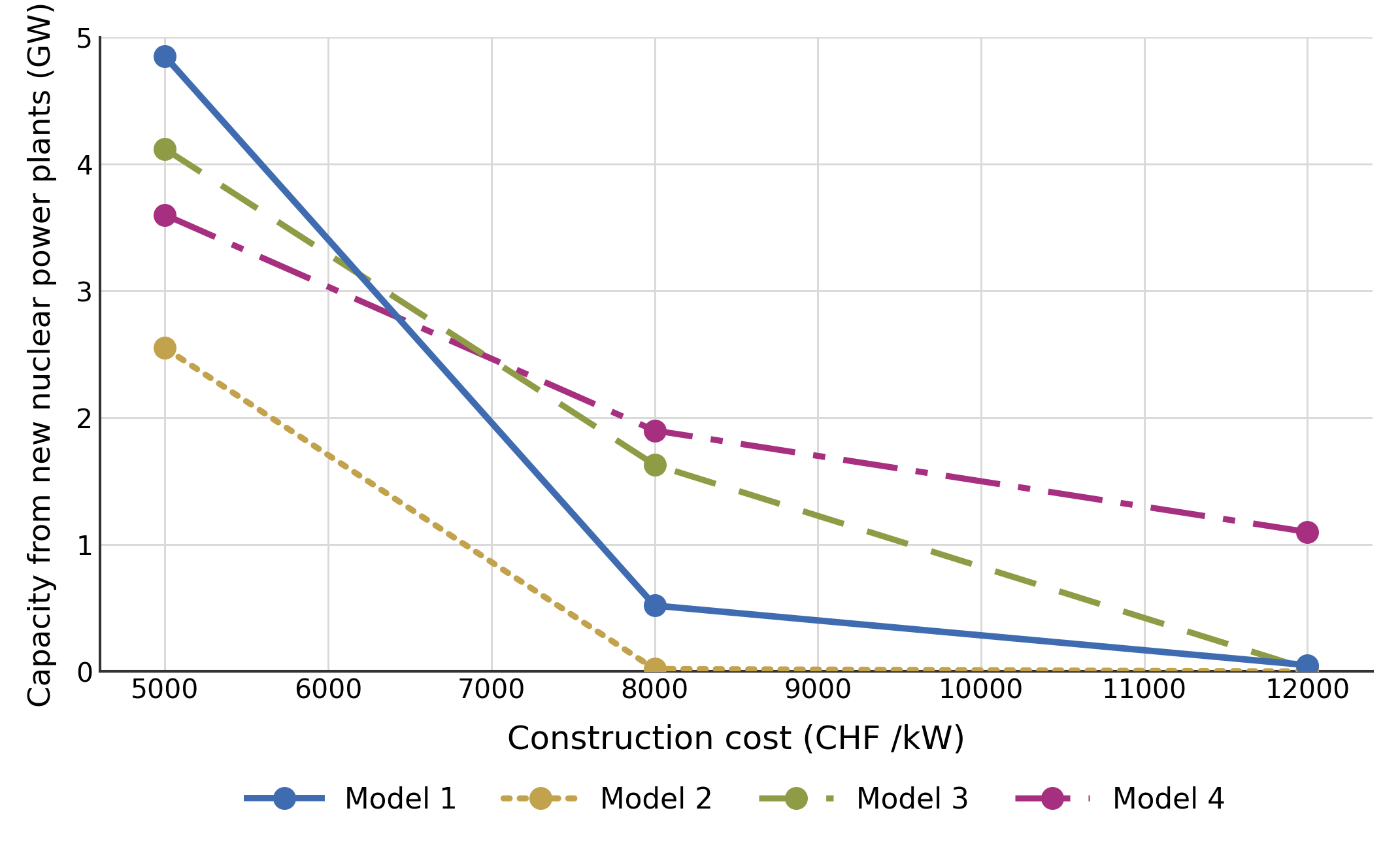
What is missing is narrower and more expensive. First, deadlines that bind the authorities, of the kind the Acceleration Decree now applies to large renewables projects: technology neutrality is not only about what may be built, but about how long the state may take to answer. Second, a rule on frustrated expenditure, since Art. 12 para. 2 places the entire loss of a failed framework procedure on the applicant, a defensible allocation when nobody was expected to apply and an expensive one now that Parliament wants applications. Third, sequencing: requiring proof of secured financing before a political decision no one can compel inverts the order in which infrastructure is actually financed. Fourth, an instrument rather than an unused option: a contract for difference, squared against the Electricity Supply Act, the Energy Act and the 2024 electricity package, treated openly as state aid, and negotiated with the Swiss–EU electricity file in view rather than around it. Pautz points to the same instrument, and to the Swedish combination of low-interest state loans and state co-ownership. Build cost per kilowatt matters, but next to these it is second order.
5. What has to be on the table before the vote?
The calendar is tighter than it looks. The Federal Chancellery reserves 28 February 2027 as the first federal voting date of that year, and the Federal Council settles at least four months beforehand which items actually go to the ballot. The substantive decisions therefore have to be visible this autumn, not in the new year: which risk-transfer instrument the Confederation contemplates; who absorbs construction-cost overrun; what becomes of sunk pre-development cost when a stage fails; and how the long tail is funded, meaning nuclear liability and the decommissioning and waste-disposal funds under Art. 77 KEG, bearing in mind that waste from any new plant would need its own framework licensing procedure for a repository.
On that last point the law is more revealing than the political debate. Art. 80 para. 4 KEG provides that where covering a shortfall is not economically bearable for those subject to the top-up obligation, the Federal Assembly decides whether and to what extent the Confederation contributes to the uncovered costs. The state already stands behind the back end of the nuclear balance sheet.
The other side of the argument
The alliance that launched the referendum on 30 June argues that new plants would deepen Switzerland's dependence on uranium imports from Russia, slow the expansion of renewables, and cost billions. Those objections deserve answers rather than dismissal.
Two are answerable. Dependence is not avoided by choosing renewables but relocated, to Chinese solar manufacturing and to the rare earths wind turbines require, as Pautz notes. And uranium can be stockpiled in a way gas cannot, from a supplier base running from Australia and Canada to Namibia and Kazakhstan. Cost is a reason to structure financing intelligently, not to rule out a technology. The third objection is the strongest: neither the financing architecture nor the procedural reform is on the ballot. On that we agree, and draw the opposite conclusion. A vote on an incomplete framework is an argument for completing the framework before the vote, not for rejecting the option and discovering in the winters after 2035 that the alternative was permanent import dependence.
Our view
Our position has not moved: Switzerland needs new nuclear. A firm domestic baseload on the order of 25 to 30 terawatt-hours, roughly today's nuclear share carried into a larger system, is what energy sovereignty actually looks like, and the designs that would supply it, including the small modular units now approaching deployment, are markedly safer than the plants they would replace. Pautz puts that comparison more sharply than we would: «Zehn weitere Jahre Betrieb von Altanlagen sind riskanter als ein neues AKW.»
Switzerland has built a fast lane for one set of technologies and left another on a road it has not resurfaced since 2003. The asymmetry inside the nuclear regime is sharper still: the Confederation has left the risk at the front of a project uncarried, where it is cheap, calculable and would move the financing cost that decides everything else, while the law already has it carrying residual risk at the back, where it is open-ended.
In July we wrote that permission without financing is symbolism rather than location policy. The same is true of permission without procedure. The correction is not to demolish a licensing stage and call it acceleration. It is to bind the authorities to deadlines as the law now binds the applicant, to say what happens to frustrated expenditure when a stage fails, to sequence the financing condition so that it follows the political decision instead of preceding it, and to legislate an instrument an investor can underwrite. Permission that cannot be relied upon is not an investment framework. Switzerland has one autumn to turn one into the other.
Dr. iur. Alexander Schiemenz is a co-founder of TND Universe, which creates, invests in and delivers real estate, mobility and energy solutions across their full lifecycle. If you are assessing an energy infrastructure position ahead of the vote, we advise on permitting risk, financing structure and the legal architecture that decides whether a permitted project is a bankable one.
Sources
1. Nuclear Energy Act (KEG), SR 732.1, consolidated text. Fedlex: https://www.fedlex.admin.ch/eli/cc/2004/723/de
2. Acceleration Decree for renewable energies, in force 1 April 2026. Federal Office for Spatial Development (ARE): https://www.are.admin.ch/de/beschleunigungserlass-erneuerbare-energien
3. Indirect counter-proposal to the "Blackout stoppen" initiative, explanatory report (provisions deleted; no compensation on refusal; separate licensing procedure for a repository). SFOE/DETEC: https://www.newsd.admin.ch/newsd/message/attachments/91232.pdf
4. Federal Council message of 13 August 2025 on the indirect counter-proposal. admin.ch: https://www.admin.ch/de/newnsb/GIECKzWVs6ZX6W1ba4i6X
5. UREK-S of 20 January 2026, recommendation to lift the framework-licence ban. Parliamentary Services: https://www.parlament.ch/press-releases/Pages/mm-urek-s-2026-01-20.aspx?lang=1031
6. Council of States decision of 11 March 2026, financing condition. Parliamentary Services: https://www.parlament.ch/de/services/news/Seiten/2026/20260311124425486194158159026_bsd112.aspx
7. Launch of the referendum on 30 June 2026 and the alliance's arguments. Federal Chancellery media announcement: https://www.admin.ch/de/medienkonferenz-nein-zu-neuen-akw-lancierung-des-referendums-gegen-das-atom-gesetz
8. Reserved federal voting dates; Federal Council fixes the agenda at least four months in advance. Federal Chancellery: https://www.bk.admin.ch/ch/d/pore/va/vab_1_3_3_1.html
9. Interview with Andreas Pautz (EPFL / Paul Scherrer Institute), Neue Zürcher Zeitung, 10 August 2026
10. TND Universe, "A Permit Is Not a Power Plant" (13 July 2026): /news/a-permit-is-not-a-power-plant-switzerlands-half-decision-on-new-nuclear
11. TND Universe, "Sovereignty, supply gaps, SMRs" (11 June 2026): /news/five-five-sovereignty-supply-gaps-smrs-what-needs-to-be-understood-before-switzerland-decides-on-nuclear